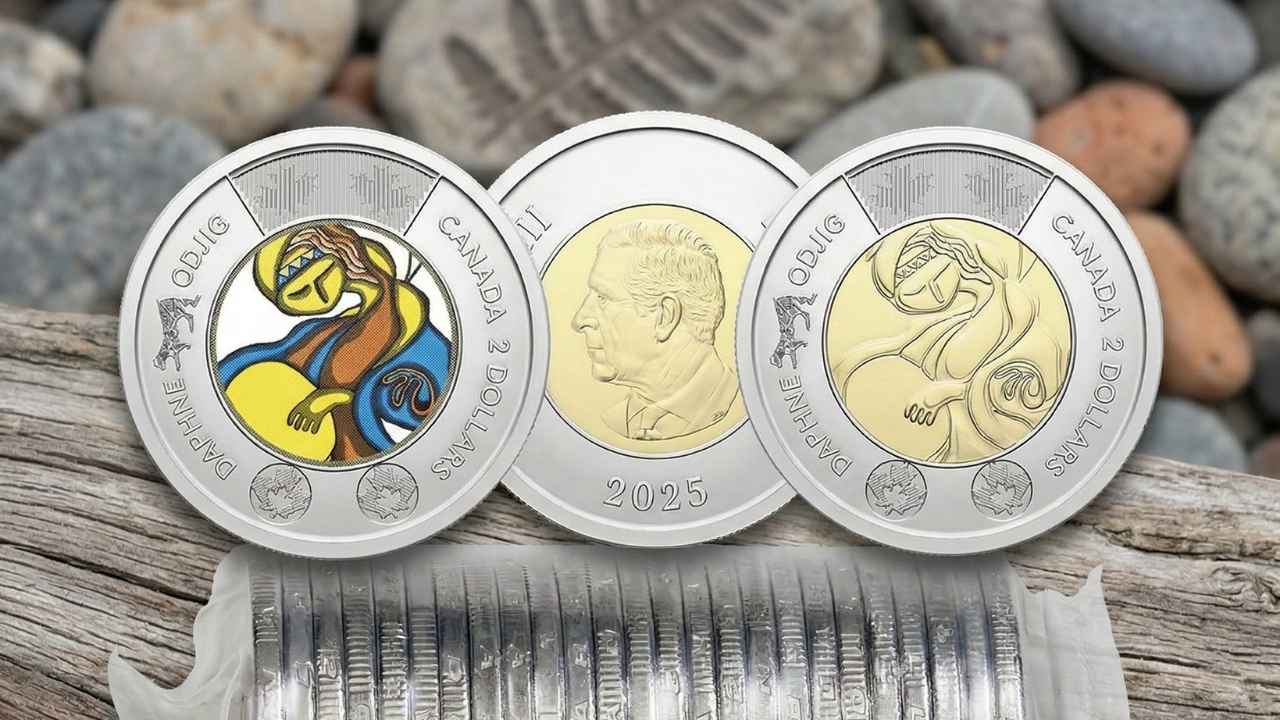
Royal Canadian Mint Celebrates Daphne Odjig: The Royal Canadian Mint has introduced a new $2 circulation coin that celebrates the life and art of Daphne Odjig, one of Canada’s most influential Indigenous artists. This coin is more than currency. It is a cultural statement, a recognition of Indigenous creativity, and a tribute to a woman whose work reshaped the artistic landscape of the nation.
Who Was Daphne Odjig
Daphne Odjig was born in 1919 in Wikwemikong, Ontario, into the Odawa-Potawatomi community. From an early age, she showed a passion for drawing and storytelling. Her art became a way to preserve traditions, explore identity, and confront the challenges faced by Indigenous peoples. Over the course of her career, she developed a distinctive style that blended Indigenous themes with modern techniques, creating a visual language that was both deeply rooted and boldly innovative.

Odjig was more than an artist. She was a cultural leader and activist. She co-founded the Professional Native Indian Artists Inc., often called the “Indian Group of Seven,” which gave Indigenous artists a platform to showcase their work and demand recognition. Through her leadership, she helped shift the perception of Indigenous art from craft to fine art, opening doors for future generations.
The Symbolism of the Coin
The $2 coin is significant because it places Indigenous art directly into the hands of millions of Canadians. Unlike gallery exhibitions or limited collector’s items, circulation coins are used daily. They pass from person to person, silently carrying stories and symbols. By featuring Odjig’s work, the coin ensures that her legacy is not confined to museums but woven into everyday life.

The design draws inspiration from her pieces “The Folk Singer” and “The Indian in Transition.” These works reflect her ability to capture both intimate cultural moments and sweeping historical narratives. The imagery on the coin includes a female figure holding a drum, surrounded by Odjig’s signature flowing lines and symbolic forms. It is a visual reminder of continuity, resilience, and transformation.
Art as Storytelling
Odjig believed that art was a form of storytelling. Her paintings often depicted community life, ceremonies, and oral traditions. At the same time, she addressed themes of colonization, identity, and survival. Her work was not only beautiful but also deeply political, challenging viewers to confront uncomfortable truths while celebrating resilience.

By placing her art on a coin, Canada acknowledges that these stories are part of the national narrative. The coin becomes a tool of education, sparking curiosity and conversations about Indigenous history and culture.
Representation and Recognition
Representation matters. For Indigenous communities, seeing their culture reflected in national symbols is empowering. It validates identity and affirms that their heritage is valued. For non-Indigenous Canadians, it serves as an invitation to learn and engage with histories that have often been overlooked.

The coin is part of a broader movement to recognize Indigenous contributions. In recent years, Canada has issued commemorative coins, stamps, and public art projects that highlight Indigenous voices. Odjig’s coin stands out because it celebrates both her individual achievements and the collective resilience of Indigenous peoples.
The Evolution of Odjig’s Style
Odjig’s artistic journey was marked by evolution. Early in her career, she focused on fine-line sketches and minimalist forms. Later, she embraced bold colors, sweeping curves, and layered symbolism. Her work often blended Western artistic techniques with Indigenous storytelling traditions, creating a unique style that was instantly recognizable.

Her influences included her grandfather, a stone carver, and her own experiences growing up in Wikwemikong. She drew inspiration from community life, ceremonies, and oral traditions. At the same time, she was unafraid to tackle difficult subjects, including the impacts of colonization and the struggles of Indigenous women.
Awards and Honors
Odjig’s contributions were widely recognized. She was appointed to the Order of Canada and received the Governor General’s Award in Visual and Media Arts. Her work was exhibited in major galleries across Canada and internationally. These honors reflected not only her artistic talent but also her role as a cultural ambassador.

The $2 coin adds another layer to this recognition. Unlike awards that remain within artistic circles, a circulation coin reaches the entire population. It democratizes her legacy, ensuring that her contributions are acknowledged by all Canadians.
The Role of the Royal Canadian Mint
The Royal Canadian Mint has a tradition of issuing commemorative coins that celebrate Canadian history and culture. By choosing Daphne Odjig, the Mint highlights the importance of Indigenous art within the national narrative. The coin is both a tribute and a teaching tool, sparking conversations about who Odjig was and why her work matters.
The Mint emphasized that Odjig was a pathbreaking advocate for Indigenous art and culture. Her immense portfolio, ranging from intimate sketches to monumental paintings, reflects the diversity of her vision. By adapting her work for the coin, the Mint ensures that her art continues to inspire and educate.
Cultural Impact of the Coin
The release of the coin has cultural implications beyond its monetary value. It serves as a symbol of reconciliation, recognition, and respect. For Indigenous communities, it is a moment of pride. For the broader Canadian public, it is an opportunity to engage with Indigenous art in a tangible way.

Coins are often overlooked as mere tools of commerce, but they carry symbolic weight. They reflect what a nation chooses to honor and remember. By placing Odjig’s art on a coin, Canada signals that Indigenous culture is not just part of its past but an integral part of its present and future.
Currency as a Canvas
Currency is functional, designed for exchange, yet it also serves as a canvas for national identity. When art is placed on currency, it gains a new dimension. It becomes part of everyday life, accessible to all, regardless of background or education.

Odjig’s art on the $2 coin exemplifies this intersection. Her work, once confined to galleries and exhibitions, now circulates in pockets, wallets, and cash registers across the country. This democratization of art ensures that her vision reaches audiences who might never step into a museum.
Inspiring Future Generations
One of the most important aspects of this coin is its potential to inspire future generations. Young Indigenous artists can look to Odjig as a role model, seeing that their culture and creativity are valued at the highest levels. The coin becomes a symbol of possibility, showing that art can shape national identity and leave a lasting legacy.
For non-Indigenous youth, the coin is an entry point into learning about Indigenous art and history. It sparks curiosity and encourages exploration. In classrooms, it can be used as a teaching tool, connecting students to broader conversations about culture, identity, and reconciliation.
Conclusion
The Royal Canadian Mint’s $2 coin honoring Daphne Odjig is more than currency. It is a celebration of art, culture, and resilience. It acknowledges the contributions of one of Canada’s most influential Indigenous artists and places her legacy into the hands of millions. By featuring her work, Canada affirms that Indigenous voices are central to its identity and future.
Odjig’s life and art remind us that creativity can be a force for change, a means of healing, and a way of preserving heritage. The coin ensures that her vision continues to inspire, educate, and empower. It is a fitting tribute to a woman whose brushstrokes helped reshape the cultural landscape of Canada.